Showing posts with label Furniture. Show all posts

Monday, July 5, 2021

Returning to the Workplace After COVID-19


More and more businesses are starting to work towards reopening, and it is crucial that they are mindful of the changing advice and restrictions from the government. Employers need to plan any return to the workplace carefully to ensure that they look after their staff’s wellbeing.

Risk Assessment

One of the first steps to arranging a return to work after COVID-19 needs to be completing a risk assessment. This will enable the business to understand what should be done to ensure the safety of staff members. A COVID-19 risk assessment should cover the situations that might cause the virus to be transmitted, the chances of an individual being exposed, and how the risk can be removed or controlled.

Social Distancing

Guidelines state that where possible, workers should be kept two metres apart. Where this isn’t possible, workers can opt for a one metre distance with added measures to mitigate risk. One way to do this in office spaces, for example, is to invest in Perspex protective desk divider screens, like those available from Furniture At Work.

Hygiene

Frequently wiping down surfaces and keeping the workplace clean will reduce the likelihood of COVID-19 spreading. Employers should work to keep workplaces clean and encouraging staff to wash their hands frequently will help keep a business COVID secure.

When completing a risk assessment, employers need to consider providing the placement of handwashing facilities. Handwashing facilities or sanitiser should be available for employees as they arrive at or leave work, and additional facilities should be available for use during the day.

Vulnerable Workers

It is crucial that employers consider the risk to any workers who are especially vulnerable to coronavirus. Public Health England has identified individuals who may be at a greater risk of infection or an adverse outcome, and this includes older males, those with a high BMI, individuals with conditions like diabetes, and individuals from some Black, Asian, and minority ethnic groups.

The government has encouraged employers to work with individuals who have been defined as clinically extremely vulnerable to ensure any return to their workplace is safe. Where possible, it is recommended that individuals who are considered extremely vulnerable are supported to work from home.


Tuesday, May 11, 2021

Tips for Setting Up Home Office Filing


Working from home is something that more and more people are doing on a regular basis. Therefore, keeping an optimum home office set up is important to ensure productivity levels are the same as in the office.  


As a starting point, this involves getting the right office furniture, but there is more to it than that. Taking the time to set up a home office filing system help home workers not to feel swamped by paperwork and documents.


The Benefits of a Home Office Filing System


Decide on a System 


Before getting started, consider the paperwork that needs storing and how you usually search for it. For example, if invoices need storing, consider how you would usually search for them. Searching by name would benefit from alphabetising, whereas searching by account number would benefit from numerical filing. 


Colour Coding 


Colour coding has been an office organisation tactic for decades. To start, sort paperwork into a select amount of categories – for example financial, contracts, or bills – and assign each category a colourColoured folders, labels and tape can all help workers to quickly assign a colour to a category. 


How to Digitise Filing


Schedule Organisation Time 


Even the best filing system will not stay organised on its own. Make sure to schedule in time once a week to file new documents and give the filing system a once over. Working on the system regularly and in small chunks is much more manageable than trying to file a lot of documents all at the same time. Setting up a recurring reminder can help you to stick to your schedule. 


Furniture 


The amount of paperwork that needs filing and the space in which to do it will determine the exact type of furniture that a home office will benefit from. Filing cabinets can help in offices with more space, but if space is at a premium, desk drawers might be a better choice. Furniture At Work offers a wide range of office furniture including drawers, filing cabinets and desks that can help maintain a tidy, organised office. 


Organising A Home Office Filing System


Tuesday, March 2, 2021

How to Use Your Work Noticeboard Effectively


A noticeboard is a great way to share and display important information, such as bulletins, reminders and memos, and is also a great place to keep the latest health and safety notices.  


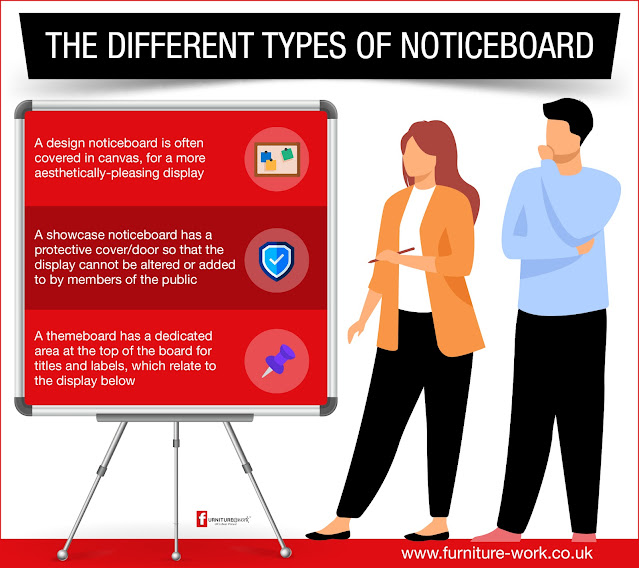
A quick and immediate way of communicating important information, a noticeboard can be located on the inside or outside of an office. Office furniture supplier Furniture At Work offers a huge range of noticeboards, including those for indoor and outdoor use, as well as in different materials including aluminium, cork, felt and magnetic. Please refer to the embedded PDF to compare notice boards and whiteboards. 


It is possible to find a noticeboard that perfectly suits each space, such as one that hangs on the wall - either portrait or landscape - or a freestanding one that can be easily moved from room to room.  


A business noticeboard can be used in any way that best suits the business and/or employees, making it an effective place to share reminders, information about upcoming events, important updates, HR information, memos, and bulletins . There are a number of factors to consider when using a noticeboard, and for maximum efficiency, it is important to choose the best location, content, and layout. 


Location 


In order to be effective, a noticeboard must be in a good location. When deciding upon the location, consider who it is aimed at, and once that has been decided, find a place where those people are most likely to see it. A staff room or a foyer are often the most effective places, as these areas are unavoidable. Hang the board at eye-level so it is easy to access and the information is easy to see.  


Content 


The size of the noticeboard will dictate what sort of content it can hold. For example, posters can be displayed on a large noticeboard but not on a smaller one. A smaller noticeboard is better suited to smaller leaflets and memos - and is therefore a better choice for individual use - whereas a large board is more suitable for communal use.  


Any content should be displayed in a neat and well organised manner, where old information is removed in order to make space for the latest memos. Avoid layering content, and ensure that the board remains tidy by attaching papers with a drawing pin in each of the four corners.  


Layout 


Consider splitting the board into different sections, which can make it easier for people to find the information they need. Use tape to create sections, hang several notice boards, or choose a combination noticeboard.